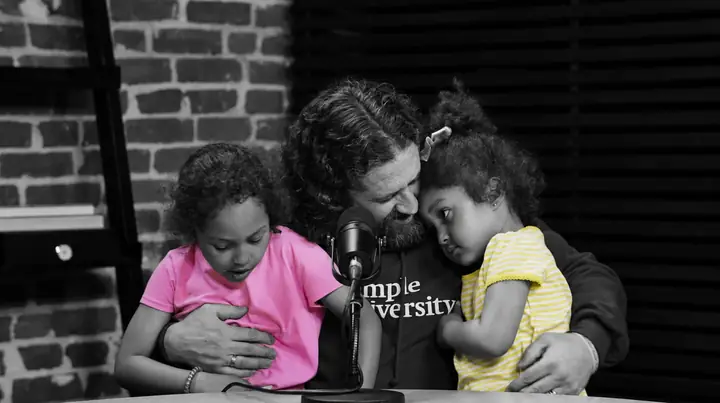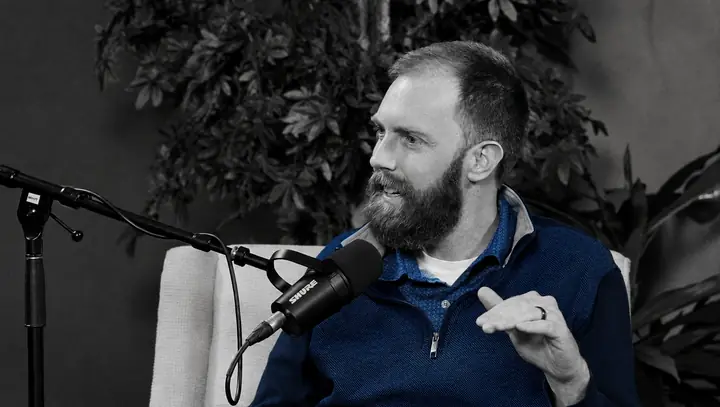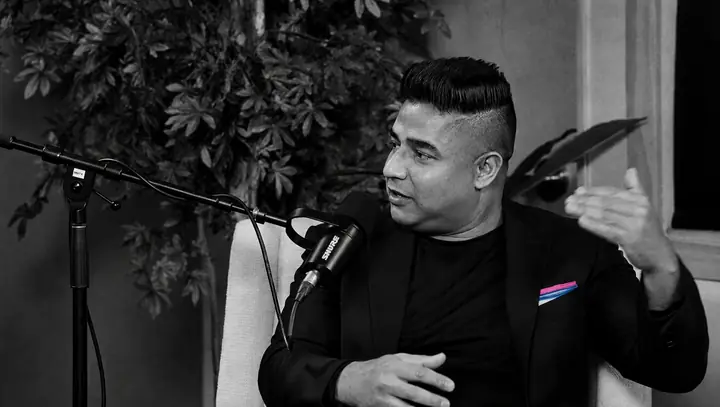
cohort after dark 04 · 25 Sep 2026 · 48 min
“My price went up.” Cindy Okosun and James Jeansonne on why they chose a DBA
About this episode
Cindy runs data and digital transformation programs for multinationals and came to the DBA to close the gap she kept seeing between practice and theory. James is a marketing and PR leader from Ohio who finished his master’s at Temple over Zoom, heard a professor ask “who’s going to keep going?”, and five years later put his hand up. Why a DBA and not a PhD, the surprise nobody warns you about (the cohort itself), the alumnus who said “my price went up,” and a long, honest stretch on AI: the eclipse you shouldn’t stare at, the tool that knows you versus the fresh account that doesn’t. Kevin joins to ask about dissertation topics, the stack of unread books, and what it takes to fly in for a doctorate.
Recorded on a residency weekend, with both guests straight off a plane. Unscripted, after class.
Key moments
- Why a DBA? The gap between practice and theory
- “Because it’s there”: James’s reason, and Dr. J
- The interview with Dr. Lynne Andersson
- The biggest surprise: the cohort
- What happens after a DBA? “My price went up”
- First-gen versus a house of scholars
- AI: the eclipse you shouldn’t stare at
- The AI that knows you, and the one that doesn’t
- The class that surprised us: statistics
- Residency weekends and the DBA pen
- Kevin joins: dissertation topics
- Golden visas, Portugal and Ireland
- The books we’re not reading
- Flying in for a doctorate
- Wrap
Full transcript
auto-generated from the recording and lightly corrected for names · select a time to play from there
Welcome to After Dark.
Today we've got James Genison and Sidi Okosun,
two cohort classmates of mine,
and we're just gonna see what happens.
I kind of threw them into the situation like we always do.
And today we'll find out what they talk about.
Hope you enjoy.
So why did you decide to do the DBA?
Oh, that's a very deep question.
Well, not so deep actually.
So for me, I love academics,
But aside that, I realized that while I was practicing,
there just seemed to be some gap with respect to practice and theories.
So, for instance, I'm in the data transformation space,
so I do a lot of modernization and project management
and program and portfolio management.
And a lot of times you have people that have that practical experience but when it boils down to
seeing a problem, dissecting that problem and actually trying to understand, you know, existing
theories as to why, you know, this problem may have come into existence and trying to, you know,
from the hypothesis, I think I'm now diving deep into DBA, so following the hypothesis and
and deciding, OK, what really could have caused the problem?
What really is the root cause?
A lot of times from practical experiences,
we just go straight into the root cause analysis
and we don't really delve deep into what the actual problem is
by taking the real data and analyzing it,
and of course, getting the outcome.
So I saw a need for me to actually get
that academic knowledge, understand
how to search for theories, relates those theories
to the problems within the organization,
and at the same time ensure that we actually
get the right data and know how to analyze the data
and then come to a reasonable outcome.
And so I said, OK, this is something I want to do.
I currently consult.
It was an opportunity for me to bridge
that gap between the practical and the academia.
And then, of course, ensure that we are,
I am at par excellence, in quotes.
So that was really my reason
for going to the doctorate program.
And interestingly, I had quite a number of friends
that were also exploring the doctorate,
but I had more friends that were doing the PhD program.
And when I sat down and compared the two,
I was like, I think that a DBA is more appropriate for me.
and you know, I just give it a go.
Have there been challenges?
Of course there have been,
and probably we'll talk about that.
But what about you?
Why did you go for a DBA?
Well, I mean, a couple of reasons.
I think the first one, which is not the best reason,
is because it's there.
And I finished my master's with Temple.
And I remember like-
Oh, you did?
Yeah, we did.
And we had like a Zoom graduation, you know?
And I remember, I was a professor, Dr. Amy Lavin,
asked like, okay, who's gonna keep going?
And my hand was kinda like,
can I, can I not?
And so I kept thinking about it.
And then after five years after that,
I was like, all right, let's do this.
My kids are grown, they're 21,
and so they're finishing college.
And so, you know, what else am I gonna do?
and show them that they must be so proud.
Your dad is doing DBA.
I think they're kind of like,
dad, we're finishing and you're getting back into it.
And they're gonna call you Dr. James?
You know, I've been telling them Dr. J,
but I don't know how that's gonna fly.
Dr. J actually sounds good,
but you need to probably get some copyright from Dr. G.
Probably, probably.
But the other reason is like,
I think about like, you know,
post corporate like career, right?
And so I would love to be in a spot
where I'm working in academia
and I'm able to like teach and write and research
and I wanna do that, you know, not just like in the States,
but I, you know, I love to travel.
And so I would love it if it was like one of those things
like, you know, James, we need an English speaking
professor and Kyoto, do you mind going for a semester or two?
I'm like, yeah, sign me up, like let's go.
That would be amazing actually.
And thinking about it, I love to teach as well.
I had the privilege to teach in colleges.
And so I thought it would be, you know,
if I had to my heart to have that title as well.
What do you think?
Yeah, for sure.
And I've definitely spoken to quite a number of folks
that, you know, post DBA,
they were able to harness a lot of benefits
in terms of, you know, consulting gigs,
in terms of, well, I wouldn't use the word integrity,
you know, something like that along that line.
But yeah, so people believe and trust more in them
just because they've gone through that rigorous,
you know, yeah, because it's rigorous.
You know, you give a little like hat tip
to people that are like, all right, you've done it.
You've gone through it.
First year, but you know,
I'm already getting into the weeds of,
well, this is not as easy as I thought,
but at the same time,
I'm already harnessing the benefits.
I'm already beginning to see the impact
even in my current space as a corporate, you know.
So I'm seeing the impact of, you know,
some of what we are gaining from the classes
and from the doctors.
It's been amazing so far.
I remember when I signed up for the program,
first time I had that interview with,
was Dr. Lynn Anderson?
She was amazing.
And she said,
well, Cindy, I think that this would do very well for you.
You have the experience, you have the,
So it definitely will be, and it's been amazing.
It's been everything she said,
but then you get to start to have some Jesus
when you start to think about the deadlines
and the RP1s and RP2 and RP3,
but then you get in there.
What's been the biggest surprise for you kind of going in?
I think for me, it hasn't been the program
because I did expect some of the regals.
I would say it's the group, the team,
people. I didn't expect the intensity of collaboration and engagement and support that comes from
every one of them. I thought it would be just going into study and then I would just do
my individual thing and read my books and have to pass my exams and have to learn.
But then, even when we are not in residency, you know, you're at home, you're working,
you still have your group members reaching out to you and checking on you and supporting
you and there is a lot of all that, you know.
It's really, really fantastic.
So that has been the surprise for me.
And there are times that you really want to feel like I'm done, like it's tough.
And I did feel like that at some point, you know, thinking about all the work I had to
put in and the time and the efforts and the late nights, you know, reading and doing assignments
and doing interviews, like we just had to do one for the hit field and run, but then
you have this people that are pushing you and telling you you can do it.
I'm going through this too, but this is how we can support each other to get there.
So it's been a huge surprise for me,
but of course a welcome surprise.
Right, right, because it's what you don't realize going in
that you do once you're in it is,
we're all in this together.
Yeah.
We're all doing it together
and everyone has a different background going into it.
And everyone in that room is an absolute genius.
Yeah.
Everyone is an expert at where they are.
I know, right?
Yeah.
Sometimes I'm so dumbfounded
seeing so many subject matter experts in the room
everyone is you know and we have people you know it's quite the vast diverse we
have people from I think Australia from what's it from from Europe and so it's
really nice to see different people come together from you know outside the
US with one common goal and interests it's lovely and it's one of those where
I mean you could right go solo and just do it and put your head down but
you're missing out on so much. If you do that, you're missing out on knowing more
about this person and then they're gonna give you a different perspective on
maybe you didn't think about that for a dissertation in the RP-1. Yeah. Or maybe
you didn't think about this or oh the reminder of you do have the discussion
post you know to do. Yeah and interestingly my group is working on
something all of us together. It's our we're doing some sort of mini research
on what it looks like for DBA graduates after graduation, right? So what does that
post like look like? What is the impact in our professional career, in our, you
know, career growth and all that? So it's been interesting, you know, actually
sitting down to think about what it would look like for us because there's
been little research done in that area as to, you know, what happens really to
DBA graduates afterwards. And while I was thinking about that and I was, you know,
putting in abstract and looking at, you know, our data and our primary source and all that,
I had the opportunity to meet someone. She had, I think her DBA was back in 2020,
but it was in Canada, not in the US. And she started to talk a lot about the impact,
you know in her life within her network consulting gigs she started to get and she was like Cindy
I will tell you it's a rewarding experience and I'm like okay this is encouraging. Did you talk to
people that had finished the DBA at Temple because I had talked to I don't know two or three and
then like other professors like I felt like I was like trying to check every box and like okay
what do you think and especially like previous professors like okay you know me is this
something that like the water is too deep, you know, or is this something I
should go in a different direction? Did you do that same thing? Interestingly, not
on my own, but I remember that at the onset of the program we had the
opportunity to get exposed to alumnis, remember? Yeah, so they were
really fantastic in giving us a heads up on of course what was going to
happen in the program, what it would entail, some of the challenges, what we
should look out for best practices and they were also helpful in telling us
this is what the impact would be when you get out of the DBA program. I'm
trying to remember his name now but I remember him saying that he said my
price went up. Do you remember? Yes. He said my price went up. I do remember that. I've never forgotten his name
unfortunately but I never forgot that statement and I have it written
somewhere on my journal that my price is gonna go up. There's gonna be a price
increase coming up. Definitely, so yeah it's I think for me that was the point
when I really engaged with alumni folks that had graduated and aside that I've
engaged a lot with of course the second year students so we get a lot of you
know feedback from them on how the program is going what their plan is for
the future. And it's quite encouraging to have a community
of people that you can, you know, engage with and, you
know, talk to and can give you insight on, you know, what's
happening and what is ahead of us, right? Yeah. And for you,
how is your family taking it though? Are they excited about
it? Or, you know, it's, it's interesting. Like, I was gonna
ask you, like, do you come from like, a family that like
everyone's like, gone to college and gone through
masters and then get some kind of doctorate so that's that's new for me
and my family so I'm a first-gen like getting an undergrad and getting
masters and now you know going through this and so I think they're like you
just can't finish you just can't be done and I promise I'm like no this this is
it I love that you're set in the president so definitely very soon your
kids will be telling you I want to think I should go for a doctorate and my
That can be a doctor, and I'm still studying master's.
Yeah, interestingly, I do come from a family of,
I don't know what I'd call them, scholars now.
But my young brother, who is the last born, we're about four.
He has his PhD, actually just rounding up.
Yeah, just rounding up his PhD.
He's currently doing, also working as a research
assistant.
And that's the last kid in the house.
But then the third one just rounded up his master's,
I think about a year, two years ago.
I do not know if he would go for a PhD or a DBA.
We'll see about that.
And then the second one in the house
is just did at a master's.
So it's possible that the other two would, you know,
follow suit, who I don't know, would, we'll see.
We'll see that when that leads.
Yeah.
But yeah, it's something I'm definitely looking forward to.
And I've started to whisper in my daughter's ears,
telling her, I would like to call you Dr. Phoebe very soon.
So hopefully she would take on the mantle
and start to think about going that route.
But anyway, I wouldn't push her,
but just whisper it in her ear, yeah.
So I went today or this week to,
it was a next gen leadership series
on artificial intelligence.
So fascinating, and so fascinating.
One of the professors, Dr. Solomon Moreira, so good.
It was so interesting to see how AI can help
and do different pieces.
And then we submitted for a panel
for that DBA conference in Madrid.
So hoping to hear soon, yeah.
And so Dr. Lin said she's in.
Dr. Chaturi's part of it.
Professor Katie Bex in our class, like she's going to be on the panel.
Amazing.
And so we're hoping that we get accepted for that.
Because also, you know, I love to travel and I haven't been to Madrid yet.
So that's amazing.
I'm rooting for you.
Yeah. So how has like AI been like for you and like trying to like, OK,
what what is OK to do and what's not OK to do?
Like, how are you dealing with that?
A.I. That's a very interesting topic that never goes right.
It's all that like, you know, there are some that are like, no,
don't even touch, don't even, it's like an eclipse. Don't even
stare at it. Don't even look at it. And then there are, you
know, the others are like, no, you know, this is how you can
help you with your dissertation, move these things into this
program. And, you know, it's, it's interesting.
Yeah. Personally, when A.I., you know, when the boom,
because AI has, of course, been for a very long time,
but of course, just like the dot-com era
that came in and boom,
there was that, hey, dot-com, dot-com.
AI is a tool I love to use.
artificial intelligence is great,
well, besides, of course, the tools itself.
I personally love the fact that you can use
artificial intelligence to make your self
more productive, you can get better data analysis
with using AI tools.
And I love the fact that it really just helps you become,
yeah, even organizations more productive.
But then there is a lot of conversation
around the ethical use of AI, compliance, regulatory,
and really if organizations are prepared for it.
And there's also a lot of conversations about, you know,
how it would impact humans in terms of IQ,
in terms of relying on, you know?
So there's a lot of,
and I'm picking my words very carefully
because I love to use AI, like, you know,
the claw, the grok, the chat GPD, and, you know.
Well, like what about like in your personal life?
Like, do you use it a ton?
I use AI in my personal life.
But then I'm also very,
I try to ensure that I limit the usage
so that I don't rely on it so much
that I can't even think for myself.
And I know that sounds absurd,
but as much as I use AI, I try to balance it, basically.
Interestingly, I was speaking to my daughter
the other day and she was saying,
she was given an assignment.
It was a rant.
They were required to actually generate and create it.
And she mentioned that while she was working on hers,
and trying to get creative with ideas to use,
her friend just went on and wanted
to just use AI to generate the entire content.
And she said, no, you shouldn't do that.
You should use your brain.
And she was saying, I want to do an IQ test.
I want to see.
So she actually encouraged her friend eventually
to actually be more creative
and generate the content itself.
And I thought it was really impressive
to see that the Gen, those are the Gen Alphas, right?
I think so, yeah.
Gen Alphas are, you know, seeing that AI is there,
AI is good, but are also, you know,
ensuring that the strike a balance
between using it, overly using it, and then,
so I think that for me in my personal life,
I use AI, but I think it's really important
that we start to think about how do we strike a balance?
How do we ensure that even while we use these tools,
yes, we want to be more efficient,
we want to be very productive,
we want to be ahead of the game,
but how do we still ensure that we have that hold
and have that, what's the word I'm trying to find now?
Basically ensure that we are still taking charge, right?
Even in the midst of all these technologies,
because AI has come, this is the big boom right now.
There'll be more technologies that would come.
Technologies that have been existing for a long time,
but maybe are just in the background
and then all of a sudden, boom, somebody realizes,
oh, this tool has been here or this technology has been here.
Why are we not harnessing it?
And that one takes over.
So I think that I love it, I love AI,
but I think we should also tread with caution, basically.
Right, right, I've tried it with,
obviously with making like different images.
And so I'm like, okay, how does that compare
to like just a different, you know, picture or whatever?
What can I do with that, with AI
that's gonna bring more attention
and get more organic reach than something else?
And so that's been fun.
I love doing it for like travel purposes.
And so, and it's fascinating how it learns about you.
So now when I'm like going somewhere,
like it'll know, okay James, this is the area I think
that you'd like to stay in and whatever place it is,
because you're down the road from this museum
or you're down the road from this place.
So I love that it learns, but it also,
because of that learning, it's almost like,
well what am I missing?
Just because I've done that before,
doesn't mean I wanna keep doing that.
What else is kind of in there?
So it's a challenge like that.
And honestly, it's really fascinating
to see how far AI has come.
I remember vividly when we started to use
some of those tools, you hear a lot of hallucination
and all that, but it has reduced tremendously.
It is so, so amazing right now.
And what you said just now about training the model,
I remember vividly there was a specific day
I, cause I have my own, you know, of course my account and, you know,
and then of course with time, whatever you enter into it,
it builds on that and you know,
trains itself and starts to answer you, you know,
with respect to those patterns, right? Um,
so one of these days I just used a different, same tool,
but a different account. So I just set up a new account.
It had no previous information about me.
The way it responded was very shallow. Like it was very different.
it was shallow, it did not have depth, it couldn't give a lot of information about me and then I
realized, wow, so what we're doing is everything AI and a lot of those tools are doing for us,
it's really based on us, based on what we put into it, based on what we are, so it basically turns
out information based on what we have built and what we've trained it to do. So when you compare
the tool with a tool that doesn't have your prior information. Same tool, an account that
doesn't have a prior information, it gives you very different information. Same question,
different information. One has depth, one is more structured, one is more organized. Well,
depending on if that person is organized and structured though. And then the other one is
just, you know, all over the place. So it's really interesting to see. And I think that we
really need to do more research into it. I know that a lot of people are exploring it right now,
even in our cohorts, which is fantastic. But I really want to see more behind the, you know,
the science, see more with respect to the scientific process around AI, it will be nice to see.
Yeah, I worry about that. I am training it. And I'm doing that. And then, in the process,
I'm not looking at somewhere else that could be like a cool opportunity that because it knows
what you did this last time. So you must want to do that again. It's like, no, no, no, you
You know, I don't want to go around the cul-de-sac over and over, like, you know, let's try something else.
So I find I find that fascinating.
OK. What has what what classes have you had so far that you've been like like that?
I didn't see that coming type thing.
Hmm. Would that be the I would say is that I would say it was probably Dr.
Pallavi's class.
Yeah, there were a lot of long nights
and some long formulas on that one.
She's an amazing, amazing teacher, though,
if I can call her that.
Amazing.
Gosh, she breaks it down so well.
Makes it seem so simple.
Seems so easy and simple.
You're sitting there in class and you're like,
well, yeah.
It's just, you know.
And then you go home and you're like, well, what?
How did that coefficients arrive?
You know, it was the standard deviation again, right?
But she's so amazing.
But then I did not anticipate that, honestly.
But I know that I should have seen that, of course,
you would be doing a lot of data analysis.
Statistics has to be involved.
So it was beautiful in the beginning.
I loved it.
And then when I started to get deeper into the weeds,
it took me a lot of sitting down and going back
and going through the videos again and again
and looking at my Microsoft notes
to ensure that I was actually getting it.
And yeah, I did not anticipate I would have that challenge,
but eventually, I think it was what the wow eventually, yeah.
But that was it for me.
What have you?
Oh, I mean, all of them.
But they've all had their different challenges.
Like I knew Dr. Chaturiz, I knew that class.
Okay, that's a lot.
The water gets deep for me when we start talking about,
you know, standard deviation and everything.
And so, but you're right, like I had all my handwritten notes
and she explains it and you're sitting there in the class
and you're like, well, sure.
And then you get home and you're, what was that again?
And so you go back and you watch the videos.
And I appreciated, I know that there were, you know,
some of our classmates are like, well,
you can put that in Excel,
but I appreciated learning how to like hand do it.
Exactly.
And knowing like those basics,
Like, it's like, that's the fundamentals, you know, to it.
And you have to know the fundamentals
before you can start to do anything else.
You have to know how to dribble
before you can shoot a three-pointer.
And so that was super important.
And so I really liked that one.
But every class has had, you know, a different challenge,
you know, to it.
Like Dr. Amir is like, I'm sitting in there,
I'm like, I never thought about that.
Okay, who's he, you know, he's fantastic.
and then, you know, Dr. Rambu Dambi, you know,
this semester, like the international business.
And I just, I'm fascinated by it.
And I love it.
I love that one.
I love it.
And I noticed like during like the, you know,
some of our homework things,
like someone would reference something
and I'm like, I would chase down that reference.
And before I know it, I'm looking like two, three down.
I'm like, I don't need to go down this path,
but I'm just so fascinated and interested in it.
It's so good.
Yeah, it is.
I honestly agree with you.
So we're really looking forward to SPSS this weekend.
Let's see how that goes.
I've got some YouTube watching to do now.
I'm going to watch some YouTube ahead of time on that one
because I want to keep up.
I want to keep up with it, but it's really been fun.
I've totally enjoyed it.
And honestly, I was looking forward to coming this weekend.
I'm like, I can't wait.
Like, even though I was thinking about SPSS,
I'm like, how would it go?
But then anyway, I was really, really looking forward
residency this weekend seeing everyone again and uh because we're not going to for yeah a good
five months right yeah and when i arrived i sent a big balloon face with you know a coffee saying
hey i've arrived to my group members just because of that excitement so yeah so yeah it's it's fun
when you start to like get to know the group and who you're you know you're paired with and
you start to like know their families you know and everything and it's super super interesting
and interestingly i did bring a pen that i wanted to share was a pen that was created by one of the
group members she actually customized it and put dba on it and gave every group member
at the beginning of the class it was really really nice to see yeah it was it was really nice
And any time I'm coming for residency, I always hold that pen.
And then when I'm taking my notes at home,
I'm always using that pen, because there's
just that connection I built with it.
Yeah, and kudos to Morgan.
Morgan Hutt, sorry, yeah, I was trying to remember her last name.
Morgan Hutt for doing that.
That was really fantastic and amazing, yeah.
This is where I come in.
And I noticed you guys kind of touched on it,
but you didn't go deep.
What area of research are you looking at?
What is your dissertation topic and why that topic?
Is it personal or is it curious?
Okay, do you wanna go first or do you want me to go?
I can go first. Yeah, go for it.
For me, my research topic is based
on my practical experience
and it's based on data transformation.
And I know I talked about that in the beginning.
Because that's like part of your career, right?
Yes, it is, it is me.
So I do a lot of modernization initiatives,
getting into moving companies that are looking to scale,
move from legacy and old systems into digital platforms.
For instance, you're using an old on-prem data center
and you want to move into the cloud,
or you're using an old tool like maybe Excel.
I don't think anybody does that now anyway
for workforce management and you want to move
to a human resource information system.
So that is my specialty basically.
And I've seen through my lived experience
a lot of companies that would start
with all the excitement and they are happy
that, yes, we are going into data transformation.
We are having a new platform.
And before the projects even start, they are all excited.
They have high expectations.
They have their benefits that they have done and planned
and said, hey, at the end of this program or project,
we would realize these benefits.
But then at the end of the day, they go ahead to implement.
And then some of them either fail or fail
to meet those benefits, feel to meet those outcomes
that they had planned from the onset.
And some of the reasons, or some of the,
from my observation, is that a lot of times
there is some misalignment at the top management level.
And I should call that a hypothesis now.
Go for it.
Yeah, so there is a lot of misalignment
at the top management level with respect to
what's really the defining success for them.
And so it was based on this, I said,
hey, Cindy, this would be your research topic.
So my research topic is basically gonna focus on,
and I'm still refining it right now.
Sure, sure, it's a work in progress right now.
I know, it's definitely work in progress,
it may change, who knows,
but what I'm fascinated about right now is, you know,
how top management level consensus
impacts on successful digital transformation.
And my focus would be in multinational organizations
because that's where I've spent most of my career in.
And I see that it happens a lot more in those, you know,
semi mid-sized and, you know, large organizations.
So that's my focus.
And interestingly, I do have ties
in those kinds of organizations right now.
So it's just a wonderful opportunity for me to explore it
and exploit with people that I can, you know,
connect with and reach.
So that's what my topic would be.
Nice, nice.
I'm really looking forward to being able to, you know,
dissect it and use that to actually bring value
to organizations that I work with.
And at the same time, not just my organization,
but also start to consult for organizations out there on,
hey, this is what I researched on
and this is what the outcome is.
And this is how we can improve your organization
and get you to that next level.
So, that's what I'm looking at right now.
Right now.
Yeah.
To be.
So, hopefully it doesn't change, you know?
With my mentor, because right now,
I'm in that mentor state, so we've been paired,
and I'm starting to work with my mentors
and my work plan and what it's gonna look like for me.
So, right now, it's looking good.
I will say that for free.
Okay, okay.
Yeah.
Okay.
So, what have you?
You know, I went in a direction that's not
like a career direction, so to speak.
So I got my undergrad and graduated
from the Bowling Green State University in Ohio.
And I went in journalism to start off.
And then since then, I've pivoted
and I went into marketing and public relations
and that's what I do now.
But I'm also like super interested
in history and international migration.
And so I-
International migration, interesting, okay.
And I was really interested in historically
like Operation Paperclip,
which was the United States' plan to,
after World War II, to poach the brightest brains
and to bring them into the United States
and have them contribute to the economy.
Like, that's how we have NASA today, essentially.
And so I began thinking like, okay,
Has that kind of flipped a little bit?
Are other countries starting to do that now to us?
And are they doing that through Golden Visa programs?
And so how different countries are now marketing
their country to different parts of the world
and the different ways that they're doing that.
Like Portugal, for example, is talking about lifestyle
and health and it's different and retire here.
And so they're getting those people
that are coming to do that.
And so then, but they're also then having another like crisis
as the, you know, the downside of it, right?
Like they're starting to lose out a little bit of innovation.
There's a housing, you know, costs that are going up.
Whereas like other countries like the UAE are talking about,
you know, here's where you can start your business
and here's where you can contribute.
So I find all that fascinating.
And so now I'm in a spot, you know,
working with my mentor, cause you know,
the road changes, right?
As you start to go into it.
And the best dissertation is one that you can finish.
Yep, within three years.
Right, and so right now I'm looking at,
thinking about Portugal's economy
and the peripheral economy that it has
and how it can start to turn and get more innovation
instead of just relying on the wine area up in Porto
and the Duro Valley and tourism.
And so looking at how Ireland might be a different example.
So, you know, Ireland is doing amazing in the EU right now
and they've taken on a lot of US or American policies
and doing it.
And so they've kind of become a de facto 51st state,
you know, following a lot of that.
And so now I'm kind of in a spot
where I'm comparing both of those,
but still have my eye on, you know,
that lever of the golden visa.
Because, and selfishly, like, it's helping me
because I want to be, you know, not necessarily nomadic,
but I, you know, I want to go, you know,
I want to like go and see the world and experience
and live that good story.
And so this is helping me learn different pieces of it.
Yeah, and that's really interesting
because I know to your point,
Ireland definitely has strong and friendly immigration
policies that actually encourage people to come in.
I've had quite a number of friends.
that migrated to the Ireland and, you know, come back with good stories on settling, on,
you know, starting from some of them academics, but aside from academics on their professional,
you know, how they were able to get in, how they were able to settle in, the support they
received, they get from the government, even from their family, for their families, for
their kids.
Like, it's, it's quite interesting and I agree with you that the policies that are
formed has a definite impact on whether people will be attracted to come in, and the truth
is the more people you bring in, the better you start in terms of innovation, in terms
of growth, but then there's also the risk.
There's always an opportunity cost, like you mentioned, the housing crisis and all
that, and I've seen quite a number of countries that have experienced the... they've gotten
on the backheads of immigration, right?
But yeah, I think that your topic is very interesting.
It's something I would definitely be loved to
because I'm an immigrant myself.
So, it's something I would definitely be-
Are you interested in being on the committee?
That would be lovely if I have the time.
Maybe when I finish my RP one, but how often do you meet?
I've met with my mentor, I think at official capacity
like twice, but we had talked previously.
So I had talked to Dr. Susan Madambi like in the winter.
And I was like, hey, here's what I'm thinking.
Can you point me in the right direction?
And so she directed me to someone who ironically
is at Ohio State University in my backyard.
And so, and then when I was talking with Dr. Ram Madambi,
he was like, hey, you should talk to this guy
named Dr. Deepak.
He's at Ohio State University and it was the same guy.
So I'm like, okay, I think I can meet up with this guy
now.
right person. Exactly. That's a good sign. But yeah, it would be nice to be on
comedy as well. If you want me to, I would really love to. There we go.
Yeah. All right. Be careful what you ask for here. Anyway, it would be nice. So I don't think that we'll
have to meet so often. It will be not so demanding. You know, here's something I was thinking the other
the day. So you know, the DBA is all encompassing, right? Like
it just it just takes your life. And you know that going in.
Like, you know, like, okay, I'm gonna have to give up certain
things to do this. I can't do both. And one of the things that
I've learned over like the past, you know, whatever, nine
months or whatever, I have missed reading, like,
personally, like my personal books and what I'm personally
interested in. And I now have a pile that's like, because,
you know, I'll see it on sale for 20% off.
And I'm like, I have to get that book
because I'll read it this summer.
And knowing that I'm only saving $1.50 really,
but I get it and I now have this pile like this deep.
And so I have missed like reading from like a personal level
and it's just, have you had something like that too?
You don't need to ask me twice.
I had on my goal for,
cause I usually have quality goals
to complete two books every quarter.
I'm still struggling with one.
I have zero, zero right now.
I'm still struggling with one.
I read it, I think halfway, it was something on branding
and I don't know if you had about the seven.
Anyway, it was a branding book.
And then I have the diary of a CEO by Steve Barrett as well.
I've been struggling to complete them.
So because, you know, there's so much, you know,
research articles to read and summarize and digest.
And so there's hardly that time to complete the book.
Interestingly, I am on a, what do we call it?
We call it a book club, it's a digital platform
and it's on, I think a group of friends
just came together and found it on WhatsApp
and it's starting to grow.
So what they do now is they just post the audio books,
one book every month.
So you go in, you're working
and you're doing something else
and you can just put on the audiobook on Spotify
and listen to it.
So that is helping.
For you to have brain capacity to do that.
I don't have it.
So I get done reading for whatever class
and I'm like, okay,
I just need to chill out for a little bit.
The other night I was watching,
I paid attention and I was like, wait a minute,
how long have I been watching Japanese baseball?
And I was watching the Tokyo Giants play.
And I'm like, how long have I been watching this?
I just needed like something brainless
just to like not read and not think
and just like come down like an octave, you know?
I know, yeah, sometimes we need those moments.
And even for those audio books,
I don't exactly like digest and focus.
Sometimes I'm just listening
and maybe picking one or two words.
So I don't really count it as reading for me
because yeah, you know, there are just those kinds
of slayers where you're just doing it and passing.
So, and then at the end of the month,
we come together and then, you know, do like a debrief.
So somehow something sticks, but it's not the same
as your personal reading, it's not the same.
So I agree with you, I'm struggling with that as well.
Yeah.
Here I come.
All right, to wrap us up,
I was thinking about this while you were both talking,
and I realized you have a commonality in the fact
that you travel for this doctoral program.
What challenges, what experiences would you do it again,
those type of things when it comes to traveling?
like Cindy, you just got off a plane to come to this podcast and James,
you just traveled early to go to more school before the school.
Right. Yeah. So James, what do you think? Uh, well,
I would totally do it again. Uh, there have been some travel hiccups,
you know, like I think the, um, previous DBA, like I was delayed in
Philadelphia. It was one of those where like, you know, they,
they tell you're an hour late and then you're like all right I'll hang out and
then it's like okay you're now two hours late I was five hours late leaving to
get home and that was like the longest like night five hours late and it's an
hour and a half flight it's an hour and a half flight and by the time I got home
you know I got into bed it was like 2 a.m. and and then I have work on Monday
morning so yeah and so no no I did it but it's one of those where it's like my
goodness like this is this is a lot and it makes that next week really hard it's
not necessarily that weekend because of the travel and getting there put that
next week I hit like Wednesday or Thursday and I'm just I'll tell my team
like I'm out of decisions guys can this wait till Monday cuz I'm out of
decisions right now well that must have been really tough for you and you still
have more come in. So raise up.
Yeah. But I don't mind, like the travel adds an element to it, you know,
but everyone's traveling to some degree to get here.
Mine just happens to be a little bit longer. And, you know,
we have plenty of people in class that are doing a whole lot longer than that.
I mean, at least I'm in the same time zone. You know,
some people are having to change like three hours and then they're going to,
you know, class at eight 30 in the morning on a Friday.
I don't know how they do it.
Ah, there's a good idea about caffeine, right?
There's gotta be some caffeine.
Yeah, most likely.
For me, it's been interesting.
And the funniest thing is I had someone ask me
this very question this morning.
Traveling, you know, going, how are you finding it?
That was an exact question.
So hearing this, I'm like, OK, this feels like deja vu.
So yeah, interestingly, it's been, it's been,
I would say, fun for me, up until today.
Oh yeah?
Yes, it's been fun.
I've, of course, experienced challenges, you know,
trying to juggle because of the kind of work I do.
A lot of them are mission critical projects that I handle.
So a lot of times I'm having to really squeeze myself
to take some time off to, you know,
be in the program and do that travel.
The first few times though, when I was on the plane,
I didn't realize I was essay until the first two times,
I was like, I just need to get down.
But then, by the third time and the fourth time,
it just, you know, started to feel normal.
But today was a bit different
Because I had, like I mentioned,
I handle some mission critical stuff.
So I have some projects that are going live
and then I could not take some time off.
So it was me, you know, on the road
trying to get to the airport on time
so that I don't miss my flight.
And then I got into the airport just at the break off,
you know, the folks onboarding the plane.
And then I brought up my laptop
and I started to have to send something out
and then I got onto the plane and I was still working
before I was told, hey, put your laptop under the seats.
You were one of those people, you were one of those.
Usually not, but today, you know,
I had to quickly send some stuff out.
So yeah, I think that as I'm getting into the weeds
of things and getting deeper into the program
and seeing that, of course, you know,
it wouldn't always go smooth.
And I probably just need to plan better as well,
ensure that I take time off during those period
when I'm meant to be on the program
and sort of maybe delegate some of those work.
Maybe that's what I need to do.
But yeah, it's been sweet song.
Well, sweet up until today, that's what I would say.
It makes you a better traveler, like I've noticed.
So like I try to like game it, right?
Like, okay, I'm not checking a bag.
And so like this week I was, I was here five days
and I was like, nope, not checking a bag, not doing it.
And, you know, I measure my life now
from before I use packing cubes
and after using packing cubes.
And I'm in that after using packing cubes.
And so like, I was like, I got this in three packing cubes.
I'm feeling good about myself now.
I feel professional.
I know like going through TSA,
I'm not going to get behind the person with the stroller.
That's going to take way too long.
I got to go over here to this line.
So you get a little better at that. I agree with you there even with packing my stuff
I found that I was able to pack better as well like okay
I shouldn't think this stuff this one can stay is just three days and so definitely agree with you on that one
But and I love the opportunity to actually sit on the plane and you know talk to a few persons meet a few persons
I do that. Yeah, I put on headphones and I'm not even listening to music. I'm not even listening to music
I just don't want to talk to anybody
It's like, no, I can't.
It's your downtime.
Just relax.
Especially Sunday night, going home, like, no, I can't.
Really?
I can't.
No.
Anyway, for me, it's always an opportunity for me to connect with people and networks.
So yeah, sometimes there are occasionally times when my head is just, you know, but even
today when I had a headache on the plane, I still, I still smite out the lady beside
me.
I'm like, hey, where are you from?
And, you know, we got talking a bit, so it's nice.
She didn't have her headphones on?
No, she did not.
I promise.
I've had that in my comments.
I'm sorry.
I can't.
I got this.
We should travel together very soon.
I'll force you to talk, I promise.
Probably would.
Probably would.
Yeah.
All right, that was another After Dark episode.
Really fun one.
Make sure you hit the Subscribe button.
All the YouTubers say all the things, right?
Subscribe, like, comment, all that.
But you know what?
If you got something out of the show,
that's all that matters.
See you on the next one.