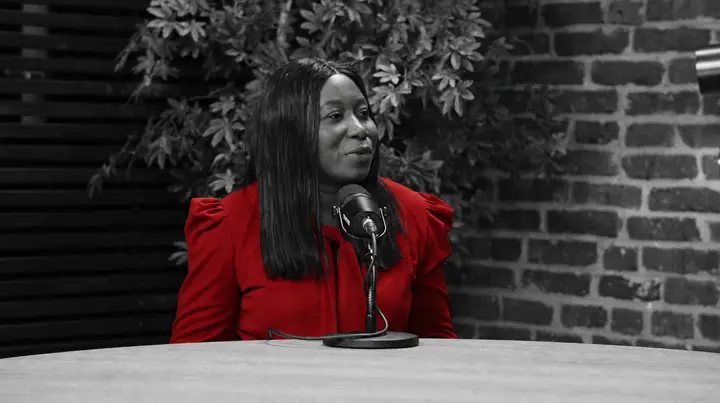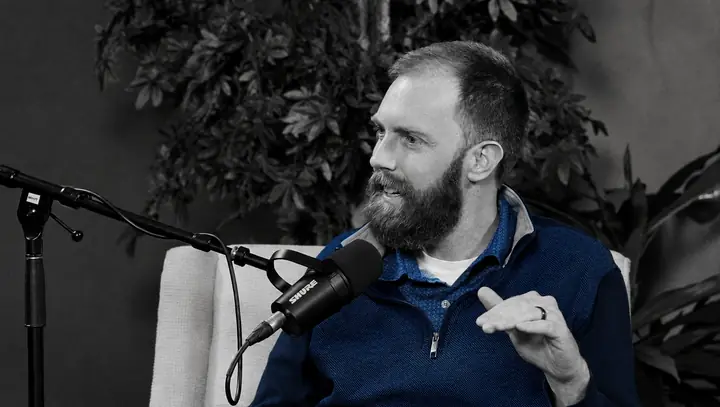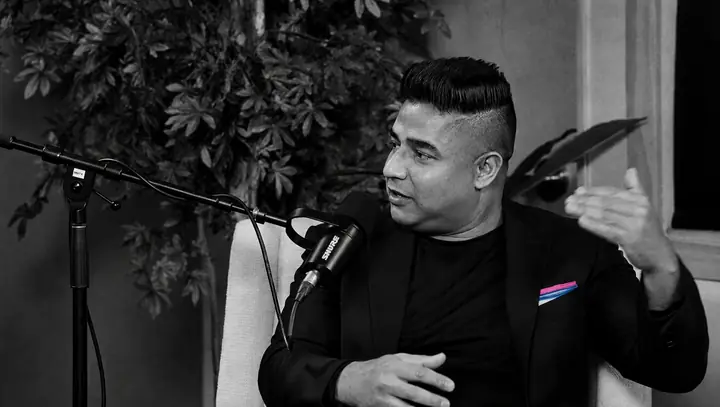
cohort after dark 03 · 25 Sep 2026 · 1 hr 9 min
“Daddy, I don’t want you to go to school.” Nathan Luce and Sade Thompson
About this episode
Nathan grew up in Utah, ran an indoor soccer arena, played college soccer at 25, did cardiothoracic research at Penn and CHOP, and walked away from med school before an MBA and now a doctorate in IT strategy. Sade was born in Jamaica and raised in Harlem, interned at Atlantic Records at 19, spent five years as a celebrity stylist, and went back for her bachelor’s during the pandemic. They talk about choosing a dissertation you love versus one you can finish, who you’re allowed to complain to when you’re the first in your family to get here, and the mirror after graduation. Twenty minutes in, Nate’s daughters climb onto his lap at the mic. Then Kevin sits down and it gets spicy: is using AI in a doctoral program cheating, or is not using it the red flag?
No script. No prep. Just real conversation after class.
Key moments
- Harlem and Utah
- Fatherhood, workload, staying true to yourself
- The dissertation dilemma
- The week everything was due
- Who are you allowed to complain to?
- Sade’s path: Atlantic Records to back-to-school
- Lulu and Faith join the table
- Nate’s path: soccer, med school, Penn and CHOP
- If you’re not uncomfortable you’re not growing
- The afterwards: becoming a researcher
- Dad guilt and residency weekends
- How do you want to finish?
- Kevin joins: who should read your dissertation?
- What do you want to be remembered for?
- Glamour versus hustle
- What does a doctor look like?
- The AI debate
- Wrap
Full transcript
auto-generated from the recording and lightly corrected for names · select a time to play from there
All right, one more episode of everyone's favorite series,
Cohort After Dark.
Today, we've got Nate Luce and Sade Thompson,
two of my favorite classmates.
One of them is actually in my group.
One of them is in group four or something like that.
But we're gonna have some fun tonight.
Let's get it going.
You're from New York.
Tell me, tell me.
Let's talk about where we're from.
Let's get into our roots.
Let's get to the root of the thing.
So I'm from, I was born in Jamaica.
I'm an immigrant.
I didn't know that.
I'm an immigrant. I am what you call a citizen born abroad. And so I was born in Jamaica
and I came to the United States when I was about a year old.
Your parents still there?
No, my mother and I flew from Jamaica here to the States when I was about a year old.
My siblings are still there. A lot of my siblings, three of my brothers are still in Jamaica.
And then we came to Harlem. So I'm from Harlem, New York.
You know how that sounds, being from Harlem. Harlem's cool.
Harlem's the dopest place on the planet outside of Philadelphia.
I hear it's not what it used to be.
It's definitely gentrified now.
I grew up in such a bad neighborhood in Harlem.
When my boyfriends used to drop me off,
there was like a bullet in print in our front door, and I was so ashamed.
Are you serious?
Yeah.
Oh, man.
This is pre-gentrification in Harlem.
Yeah.
That happened, what, early 2000s?
Yeah, I was between maybe like 17.
So I moved to Harlem after my parents divorced.
And it was a transition for me because my sister
and I went to live with my father.
And we were teenagers.
And then we moved to Harlem.
And this is pre-gentrification in Harlem.
And so I'm like, you know, I'm at a crossroads in my journey towards becoming a woman,
and I'm living with my dad for the first time, and I moved to Harlem.
That's cool. You and I couldn't be... So I'm from Utah.
Okay. Yeah, that's quite...
Very homogenous.
Okay.
Culturally, racially,
It's super homogenous, but my, you know, my upbringing was about as opposite as you can
get from Harlem.
But anyways, I found myself in Philly 30 years later, and I've been here for 20 years.
Nice.
And then we connected via this program.
Let's talk about that.
Yeah, I was just going to get into that.
How do you feel about being a father,
balancing the workload,
balancing the work-life balance,
and then staying true?
Do you feel like you've deviated a bit
from who you actually are to acclimate to this program?
Do you feel like you're the same person
that you were when you came into this program?
So I feel like a better version of myself.
Nice.
I feel, I honestly feel like I'm smarter
for having done it.
But I will say I do battle.
So this dissertation thing,
this choosing a dissertation topic,
you and I have talked about that at length.
Yeah, we have.
And we have decided, we have thought,
man, do you kind of go with your heart
to a place where you really want to save something?
Yeah.
Right, you really want to get people stirred up
and share something that's kind of changing,
but then there's this alter ego
that says just get it done.
That's the hardest discussion I think we've had
is about what's the balance between getting it done
and being practical?
And how do we kind of, do we kind of go with our gut
and do something else?
So I don't know, let's talk about that.
I feel like my mentor, shout out to Dr. G,
has put some stuff in perspective for me already.
And it's just like that balance like,
okay, we need to get this done.
How much of your own creativity can you put into this?
And then how much of it has to be structured
in a way where you'll get it done, right?
So, it's hard because I wanna have like this big thing
that I can slam on the table and say,
this is my dissertation,
but I feel like no one's gonna read it.
And so it's for me.
And so the only person that needs to like validate
this piece of work is me.
And so I need to be happy.
I need to be able to look myself in the mirror and say,
this is what I wanted to do.
this is how I wanted to do it.
And that's that.
Yeah.
And I don't feel like it needs to come to you right now.
Well, that's what I was, you know what,
I'm working towards it and I've been placed with,
so for those of you who don't know,
we're in a doctor of business administration program.
Yes. For Temple University.
We're in an executive.
Executive DBA program.
You have to include the executive part.
No, well, because it actually, so it's important
because when I started off by asking you
you balancing this, right? In order to get into the program, there's like certain credentials,
right? And so it's not just a doctoral program. The executive part pays a huge part because you
feel like you have to do something that coincides with your industry. And that's a part of the
reason why we've been kind of like... Yeah, no, the executive part is a big part. I agree.
I want to answer your question. I didn't answer your question about balancing kids and family.
Yeah, please do. Professional life. So I'm in consulting and it's a very niche
space in the consulting world where we do we do deal advisory stuff for IT
service providers so big like most of them are from India and really big
service providers who on the back end of you know Fortune 1000 companies come
in and mostly run their IT that's mostly what we deal with so consulting
I've just I have to be ready to give the hours that are required instead of
of having an expectation that I'm going to work
a certain number of hours per day.
That can be good or bad, but when you combine work
and then you've got to change your mindset completely
to go in and deliver on homework and meet deliverables
that are, I'm finding actually quite challenging.
Harder than I thought they would be.
This past week was-
Yeah.
So we can dig into that.
That almost, this one got to me.
In fact, to give people an idea,
we had how many, how many assignments were due yesterday?
We had, so we had two discussion boards, quiz.
Three, three discussion boards.
I may have missed one.
You must've done it early.
We had one for each class.
Okay, that was the one, the 15th.
Yesterday we had two discussion boards, a quiz,
the business case for the group.
The white paper. The white paper.
Hit the field. The hit the field.
Hit the field. Hit the field.
And so yesterday to give folks an idea
that this wasn't slacking,
but there's a not an infinite amount of energy
that we have to get these things done.
And so I find myself having to motivate myself
because the projects, the amount of work
we have to do is quite large.
So it's hard to get into that first thing and get it going.
So what I found is it's not procrastination,
it's just the load of it is like,
man, that's gonna be hard to tackle.
So me, I was up till 5 a.m. last night
and I got my white paper in late.
It's just the way the world works.
Like there's so much there, but at the same time,
paying really close attention to the minutia
of what we're learning.
It's actually quite detailed.
So I did my master's down at Hopkins, my MBA.
And the homework there in the coursework was,
we had a really large class.
You didn't get to know anybody
and it was just go through and do it and it was quite easy.
This is actually more difficult.
And then finally with my kids.
So I'll bring them out here in a minute.
I've got a six year old and four year old girl
and they're beautiful and adorable named Faith and Lulu.
And so they don't know what homework is for a dad.
And they actually get quite upset with me.
They're like, daddy, no, I don't want you to go to school.
I don't want you in school.
So the balancing act is pretty tough
because when they're with me, they're first.
And that kind of leads me to my next point.
I was going to ask you,
do you find it's hard to relate to other people
when you're telling them about like what's going on?
Like I almost feel like it's hard for me to complain
about the workload, right?
Like who do I call my mom?
I'm a first generation graduate.
She's like, I don't even know what you're talking about.
You know, and so then it's also like,
do you know how almost entitled you sound
when you're complaining about like work
and a doctoral program?
It's like, you're so lucky to even be here.
Like what are you really complaining about?
But it's super stressful.
And there's oftentimes I'm like,
why did you decide to continue your education past your MBA?
And then I remember there's certain glimpses
when I'm doing an assignment and I'm like,
I can see the end point and I understand why
because you're like insatiably curious
and you crave like intellectual stimulation.
And like when those thoughts start connecting,
it's like, okay, now I remember
like there's certain assignments where I'm like,
okay, now I remember why I'm here.
But then you have a week like we just had where it's like,
damn, I don't want to do this anymore, you know?
And so it's hard.
And there's no one I can really talk to about it
because I feel almost like complaining about it
is coming from like a point of privilege.
Like, do you know how many people would
love to be in your shoes, but they can't either afford it?
It's not accessible.
It's just not possible for them.
And so I find myself battling between those two things a lot.
Like you have no right to complain, get it done.
And you're gonna get it done.
You're not gonna, like there's no, you can't quit.
You already made a decision.
And so it's just about like,
how are you gonna get it done now?
Are you gonna get it done complaining the whole time?
Or are you just gonna put your big girl panties on
and just like knock it out?
And that's a conversation I have with myself almost every day.
Like it just needs to get done.
Yeah, I'm finding myself, I don't know if you're relating,
but the answer to your quandary about me
and who I find to talk to is it's taking me
to a space professionally and a little bit intellectually
because a lot of people have been down this course,
but professionally for sure to have a doctorate
in business that's not a PhD is I'm finding it wonderful
but also unique for people to respond to.
Yeah.
But that's not even the part, the part,
the part that I particularly like about it is that,
you know, I can tell that it's a unique and special set
of people that strive to get this level of education.
I will say that.
I think it's pretty unique and it's difficult to do,
especially, you know, I'm turning 51.
And I'm-
You look great.
Yeah, thank you.
You too, I know you're in your twenties,
but just saying.
I'm the youngest member of my cohort.
But just saying, honestly, I feel better having done this.
I don't regret it.
Coming into the program,
I knew it was gonna be particularly hard.
I knew that it was gonna be hard,
but I find myself needing to talk to folks.
Yeah, me too.
And the outlets are coming from my classmates
in several instances.
Like you and I have had a discussion that I needed to have.
You know, funny that we've talked about this
and I wanna jump a little bit into this,
but I'm not, I'm not doing the healthcare one.
What are you doing?
I'm doing it on tech and we'll dig more into it.
Yeah, we'll talk about that, yeah.
But I told you, I wasn't,
I wasn't feeling that vibe for a long time
and it wasn't going away.
I'm glad that you went with your gut.
Yeah.
Because you're the one who has to research this topic
for years on end.
And so you got to do what works for you.
Yeah.
And clearly you have.
Yeah, I'm living in a different space now
and I've been there for several years.
So we'll talk about that a little bit,
but I think that was one of the most relieving decisions
that I've made is to,
and it might be different than what you experienced,
but I'm just like, I can't do it.
And I kept trying to put myself into that hole
where that's the project I had to do
because I had so much experience in that.
And I just said, no, like I just can't do it.
And then I talked to my mentor
who we ended up working very well together
he's a strategy guy in IT, which strategies right, right up my
alley. And I'm just like, it doesn't matter what the actual
topic is, as long as it's in that sort of realm. So we're even
whittling down what it's going to be together. And it's better
for me. Yeah, it's better to me to not have to like, boom, this
is where we are took all the pressure off me. And I'm like,
Okay, I've got a guy who likes to explore. And that's how I
am. So from that perspective, it worked really well kind of
holding onto my guns and saying, I'm not choosing yet.
It was hard.
So you did almost make like a radical,
we were talking about like, should we go there?
Yeah, but it's not like-
It's just true to you, right?
Yeah, it's not like a radical human thing.
It's just, it's a better fit for me
for where I'm in my life.
Yeah.
There's still parts of me that wanna do
a radical human thing, like to shake the table.
Yeah.
And then I like, I told you,
I'm like, I want to get out of here too.
And so like, let's just, let's,
maybe this is the first step towards a career in academia.
I don't know.
It's not my intention, but also I'd never imagined
that I would even be in this program.
Yeah.
Yeah, the doors kind of open there.
Tell me about that experience more.
How'd the doors open?
How'd you find Temple?
What was that experience like?
Okay, so I told you my parents got a divorce.
I moved to Harlem.
I was so lost.
I was working at Starbucks, and I really,
it's just like, I didn't know what I wanted to do,
and I thought I wanted to be in the music industry.
And my dad was like, I have a friend
that works at Atlantic Records, he's in the mail room.
Give me your resume.
I was probably like 18 at the time.
I had gotten into City College University,
I wasn't going, I wasn't motivated to do anything.
It was a pretty bad divorce, and so.
And so I gave my dad my resume, and I was like,
You know what, I might as well do some email sending of my resume as well.
Anyway, I ended up reaching out to this guy named Sycamore at Atlantic Records and I interned
at Atlantic Records under him and he was like, you don't need to go back to school.
You're going to be an entrepreneur.
I'm going to take you under my wing.
I'm going to teach you everything you need to know.
You're going to work under me.
And at the time, he was managing Richard Hilfiger, who wanted to be a rapper at the
time.
in Atlantic Records, and I was working as his assistant, and I was working under Sycamore
as well at the same time. Fast word, Richard Hilfiger had a stylist, and I was like, oh,
I could do that. And after I left Atlantic, I worked with the stylist for about five
years. I'm giving you a very fast forwarded version of a long story. And I became a celebrity
I started working for myself, and then the pandemic hit.
But prior to that, I felt like something was missing.
I had grown complacent.
I felt like I was being boxed in.
And I felt like I was doing myself a disservice.
And then I ended up going back to school
during the pandemic.
Which degree was that for?
That was for my bachelor's degree.
Oh, wow.
Yeah.
Okay.
And so, actually, I went back to school
right before the pandemic.
So I was commuting to Harlem.
So this was 19, 2019.
No, this is-
2020.
This is 2019, maybe, 2019.
Right before-ish.
Right, exactly.
Okay.
Okay.
The pandemic hits, and they're like, we're going to switch everything virtual now.
And I'm like, okay, I'm going to take six classes at a time, finish my bachelor's degree.
My best friend had her master's degree.
She's like, you need to get your master's degree now.
I was like, okay.
Got my MBA.
And at that point, I was like,
I'm never going to miss an opportunity to learn ever again.
I've never seen my parents more proud of me.
I've never felt more in alignment
than the feeling that I had when I went back to school.
I've never felt more accomplished.
And I was like, oh, this is it right here.
Like, and I've been to the Grammys, the VMAs.
Like, I've done a lot.
I've lived so many lives,
but this is the most alignment I felt in my entire life.
And like I said, I'm an immigrant
and I felt like I was just not taking full advantage
of the opportunities that I had in front of me at the time.
And so I had to beg City College to let me back in.
And then after that, I was like, oh, you're like,
this is it, like, you're gonna sprint now.
And so here I am.
And so I can't complain,
cause it's like, I feel like my brothers in Jamaica
can't read, right?
And so there's no difference besides the fact
that I had an opportunity, right?
And education was extremely accessible to me.
I could walk to a library and I could download something
on my computer and so it's like I'm not gonna miss
an opportunity to learn, it's at my fingertips.
And so I'm so grateful that I found a program
like the one we're in where there's people here
who are like really committed to learning and supportive.
And yeah, like why not?
Why not like take it to the top?
Like I'm super ambitious.
So I was just telling Michael in the car ride here.
I'm like, I might like, I don't know.
I don't know if I'm gonna be finished after this.
I might like try to get my law degree.
Like I don't know, but I know that I have an obligation
to take full advantage of the opportunities
that are in front of me.
And I'm not gonna like take them for granted.
Yeah, that, that what you just said about maybe doing
law school about after this got me,
I could see you doing that, that kind of drive.
I mean, why not?
I'm not even thinking about myself.
I'm just thinking about like my family in Jamaica
who didn't have the opportunity
and I have it right in front of me.
So who am I to complain about a little discussion board post?
It's like, we're over here, we can't like read.
Like my brothers are like illiterate.
Like that's a reality, you know what I mean?
So it's not about me and you're doing this
for your daughters as well.
Like your daughters are here.
This is gonna be a moment.
I remember when I was that age and I remember, yeah, I do.
I do.
And they'll remember.
I will.
Well, I was hoping Kevin wasn't gonna be mad at me
for bringing them and I knew he wouldn't be.
It's important for them to see this.
You know, this having them here with me
is what I need to do so they can see this,
but here they come.
Come on.
You're so cute.
I know, look at this, come here.
So here they are, ugh.
I try to bring these two everywhere.
Are you gonna smile?
Are you gonna be shy?
So, this is my Lulu, six, and my Faith, four, and,
oh, sorry, do you wanna talk into the camera and say hi?
No, okay, so there's a camera,
we're getting filmed right now.
And this is Sade, she's in my class.
Hi.
So we're talking about what you do when you get older, okay?
And so I hope you have fun while you're here watching.
Yeah, and you, do you wanna say hi in the camera?
No, but so all, you know, in a similar way,
I'll share kind of my pathway.
I think it's very different than a traditional pathway.
So, and I'll give the fast version.
When I was about, I think I was 20, 21,
or 22, me and a guy that I was playing
on a college club soccer team in Utah.
And we got together and we decided
we were gonna open an indoor soccer store.
So we opened an indoor soccer store
and ran that for a few years.
And then after a few years, we opened an indoor soccer arena,
had a couple soccer fields and a climbing gym.
And I got recruited to go play college soccer.
I was 25 at the time, so I was older.
And I got recruited to go play up at Western Washington
and just below Vancouver, Canada.
And so in my very first game for them,
I got elbowed really bad in the head,
split my head open, had a concussion.
And so I'd had several concussions
and decided it was time that I couldn't play anymore.
So I went back to school
with the dream of going to med school.
And that eventually led me to come to Philadelphia.
And I worked for three and a half years
at the hospital of the University of Pennsylvania
here in Philly, and then for the Children's Hospital
of Philadelphia, doing cardiothoracic research
and decided that I still wanted to apply to med school.
So I did, I was admitted to a osteopathic medical school,
medical school but I decided it wasn't feeling good for me right and I'll get to
where I'm going but I it was it was so challenging because I changed paths then
and I couldn't find a job so I started working as a environmental services
supervisor in a hospital okay okay and my background was already in
chemistry and biology and political science and I'm like man I need a job so
took it and ended up then getting a job for the hospital and kind of progressed
up to be the practice manager at a facility and then went back and instead
got my MBA. When I got my MBA it was it was pretty tough and I was working full
time and had these two guys at the time and I didn't think I'd ever go back
right and then after that I just naturally started looking at PhD
programs and doctoral programs and and kind of deciding what the best one for me was.
And I talked to a mentor friend who kind of helped me help me kind of think about what to do.
And the DBA just felt right. I applied to two schools. I was fortunate enough to get into both
of them. And I picked Temple. I think for the reason that you and I talk about on the talked
about in a lengthy conversation was because I wanted that ability to express who I wanted
to be. And you said fitting here was what you felt. I couldn't agree more. I think that just
fitting here and feeling, you know, comfortable being challenged, certainly challenged,
but fitting is a good way to put it. I think feeling like you're in the right place where
where you exactly where you need to be.
Yeah.
My interview was with Halavi.
Mine was as well.
Oh.
Yeah.
I've never had a better interview in my life.
Me neither.
I loved that interview feeling really good.
And so I knew what decision I was gonna make
immediately after I got off the Zoom with her.
I did as well.
Yeah.
Yeah.
It wasn't a question in my mind.
It wasn't a question for even about getting in.
I felt like it went, well, for me, I was okay.
I was like, I'm not super concerned
about whether I'll get in.
I was more so concerned about what school
I was gonna choose, yeah.
Yeah, where was your MBA?
Rutgers.
Was it here living here or was it?
It was online.
Online.
Yeah, yeah, and so imagine that this is a bit of a,
I wouldn't say it's a huge contrast,
but it's like I didn't have any in-person classes.
The first time I met some of my fellow classmates
was at graduation.
Yep.
And so this is different,
but I feel like you need to do things
that make you uncomfortable consistently.
Yeah.
Because if you're not uncomfortable,
that means you're not growing.
And the worst thing you can do is stay stagnant,
especially in a country like this
where we have all these opportunities,
it's like you need to constantly be uncomfortable.
I started taking kickboxing.
You told me that.
And I'm so bad.
I'm embarrassingly bad.
I'm like, I'm out of shape, I can't do a pushup.
And I'm like, this is exactly where you need to be
because if you're in an atmosphere or an environment
where you're constantly excelling,
again, that just means that you're like,
you're not growing,
you're not allowing yourself to grow,
And so eventually I'll be able to do a push up
and I look forward to that.
But in the meantime, I have to do something
that I'm bad at until I get good.
And it's like the same thing that Lynn was talking about.
It's like this crawl before you walk concept
where, okay, like it's annoying.
She doesn't want us using AI and that's fine.
I respect it.
And I also understand why
because at the end of that assignment,
I was like, you know what?
I'm gonna take an inductive approach to this research
instead of deductive.
And I'm gonna do a qualitative analysis on 200 interviews
and my research scope is gonna be,
and I wasn't talking like this like six months ago.
I'm gonna use axial coding and the open coding
and I'm gonna draw themes and I'm gonna like,
sometimes I'm talking to people,
I'm like, what the hell are you talking about?
Excuse my French, but like, who are you?
What do you mean you're taking an inductive approach
or an abductive approach to this research
and you're gonna draw a hypothesis from it.
Who are you?
That's good though.
Cause I didn't come in this program
to be the same person that I was before I came in.
Like I'm interested in like regeneration.
Like constant regeneration.
Like that's why I said that when I start up
like I've lived like several lives already.
Like I'm not interested in being the same person
I was even last year.
And if I am, that's a problem.
Yeah, mm-hmm.
I wanna do this.
So I have something I wanna share as the after,
the after graduation, the afterwards.
The afterwards, okay, let's talk about it.
So there's a couple things to it, right?
Yeah.
First, it's, in a very real way,
we'll have a doctorate degree.
Yes.
And that's a really good thing
because I think it gives opportunities
that we couldn't have before, right?
Yeah.
I hadn't, when I went into the program,
considered that I would be a researcher
when I'm done with this program, okay?
Like that would be what I would do.
But it's almost like I'm almost having an experience
of coming into a new world of me,
a new world of opportunities.
And you talked about becoming a new me.
Yes.
Right?
And that's what I feel like this is doing.
When I was doing that, hit the field assignment.
And in the hit the field assignment,
we had to go two times for an hour each
and observe a group and determine what do we learn?
What are they doing?
Really get into it from a grassroots perspective
to understand how to observe from the outside
rather than participating.
And so I chose this app called Good Rec.
It's an app that enables folks who play recreation sports.
They don't want to be competitive anymore,
but they want to keep active.
And the app sets up times and locations for a fee
that people can go play.
Okay.
All right.
So I've been doing this for the past year or so,
but I wanted to look at it from the outside.
So I did it two times and I wrote questions
and I interviewed a couple of people.
And I was like, this is it.
Like, this is where it is.
This is something that I want to do when I'm done.
Not all of it, but it's completely different
than going to work and doing a task
with a definitive end point in mind.
It's opening my mind to be like, oh my goodness.
I get to answer questions that even though it might be
a sliver of information or knowledge,
I'm going to contribute to our knowledge base in academia,
it still was so enlightening to me.
It felt like a different level of place to be.
And I found it really, really special to be in that space.
It's interesting to hear which assignments
are resonating with different people.
Yeah, I liked that one.
I really liked Amir's class.
You liked Amir's class.
Yeah, yeah, I'm really into strategy.
I liked his approach to teaching, lecturing.
I learned more about theory in his class
than any of the others.
Yeah, I really enjoyed his class.
Let's just, I feel like we're still holding back.
Okay, go, I'm ready.
You want me to take it there?
Or ask me.
Okay, so we mentioned you being a father
and you're in this program.
And we've spoken about this briefly during lunch,
but we've already established that you love this program
that you're here.
Do you ever wish that you had more time
to spend with your children, and do you feel guilty
when you have to leave and come to residency?
Yes.
Okay, how do you do it?
I don't have children yet.
And so that's one of the reasons why
I feel like maybe I'm like pushing it off
until I'm done, that was my whole thing.
Once you get here, then we can entertain that.
Once you're a CEO, then you're done.
And then I'm like, nah, because I could just maybe,
once I sell my first company, then I'll be ready.
And so at what point do you feel like you
had to put yourself,
because you're putting yourself first, would you say that?
No.
Okay.
That's not how I feel.
Okay.
What does happen is it's constrained
because I'm in a separated relationship
and the poor kids don't get to see me accept
a certain number of times, so we're on a schedule.
And it's hard for them
when I have residency weekends coming up.
So, residencies are three days,
and they're from 8.30 to five, three days in a row.
And those twice this semester have landed on my weekend.
And so it does, it makes me feel,
it makes me feel guilty that I'm doing that,
but not from them being selfish,
but from the, dang it, they wanna be with dad.
And I can't be here.
It's kinda not a guilty selfish feeling,
but it's guilty that now's my time to be with them.
But I wanna share, so that's hard to articulate
how it feels, it's a dad feeling,
a parent feeling for me. But what I will say going into the program and my purpose and intent
with my children was that, you know, I'm an older dad, and with them, I want them to see an
experience, the full cycle of an adult education with their parents, to see that experience that
they're going through to see the words that's coming out of dad's mouth, to see the vibes that
they feel when I study, to know that when they're home with me on their weekends and they don't
recognize this. I think Lulu might a little bit, but that they're first, right? Homework doesn't
trump them. So work doesn't trump them. When it's time for kids, it's their time. So I wanted them
to experience that as a child. So when I have to do these hard things and be away from them,
or when I've got to adjust the schedule, which is hard for them, when we do that, there's a
way of method behind the madness before I got into this program that was built with
really thoughtful intent, right? So it's going through it with them
them rather than doing it for my own development, because they're seeing, they're experiencing,
they're exposed to higher education, they're getting a value out of it.
And then as dad continues to work hard and hopefully be successful, they'll see that
natural flow and it won't be a bump or a jump or anything like that, but it'll be a
natural transition where they feel comfortable in the space of learning and in the space
of performance.
It's really important to me that they learn, you were talking about being uncomfortable.
It's really important to me that they feel that discomfort in dad and how to navigate
it.
And so that's part of why I did it.
So yes, they're a huge reason that this fits me.
And I'll tell you, there are things as a dad that I do that I know I shouldn't be doing
that is not prioritizing them.
This is not one of them.
I can tell that it's a good experience for them.
They get mad at me.
They get really mad at me.
They don't want me to do homework.
They don't want me to be in school
because it takes time this week.
You know, they get ticked at me.
So it's hard for them.
It's a learning experience.
That made me think about,
it's not really about finishing, right?
Cause we're going to finish.
It's not about finishing.
I just often think about how I want to finish.
Yeah.
When I'm done, like that conversation with myself,
and I look in the mirror, like how did you finish?
And that's what I was saying about the complaining,
like were you complaining the whole time?
Yeah, you can't do that.
You know what I mean?
Like how do I want to finish?
I need to be able to obtain this degree
with the high level of integrity, right?
That's more important to me than anything
because like the degree is done in my mind, I'm done.
I've already moved on mentally to my next.
I'm like, I'm actually like moving in reverse now,
catching up to what I've already said I was gonna do,
or I've already envisioned myself accomplishing,
but it's just like, how do I wanna go about finishing this?
So I'll take that back.
I do have some times where I'm like,
man, am I gonna get through this?
It does get that hard for me.
I've had that thought come to mind, yeah.
But when I turned in my last paper today, the late one,
I was like, how did I do that?
Like I don't know how it got done.
I don't know how it ever gets done,
but it just somehow gets done.
And that's what I, I'll have these pep talks with myself
and I'll be like, well, you know you're gonna do it, right?
So let's just do it.
Cause it's not, what are you gonna do?
Just not submit it?
Like let's just get it done.
And it always gets done.
And I'm just more so concerned about like how
I'm gonna feel about myself at the end of the group.
Yeah, I feel the same way.
I'm like, did I, did I do that the way?
as hard and as honestly and as deeply as I needed to.
I already feel like there's cracks in my development.
And I'm not saying that to say I haven't been trying,
but there's articles that I didn't get a scan
all the way through.
And there's things I didn't get a read in depth
as I would like to.
And those are the things that get to me.
I really like, I even find myself saving all the articles
so I can go back and review them later
and read our books again.
So I feel the same way, very similar
in that by the time I get to the end,
I wanna make sure that the services
that I'm gonna offer to others
came from a legitimate source.
Are you completely burned out?
And it's like, well, that's what I'm saying.
Like, is it, are you burned out?
Are you feeling how,
I'm just curious as to how I'm going to feel
when this is done.
You mean when we're done, are we gonna be burned out?
I'm contemplating.
Oh, we're gonna be, yeah,
we have to finish a dissertation
that's like 250 pages long.
Yeah, it's gonna be hard.
I think if we're strategic about it,
that won't be a problem.
Yeah.
The objective is to keep reading and keep writing.
You should just be doing that.
Yeah, just keep going.
But again, that's easier said than done.
You gotta derive value from it though, right?
So it's gotta be a meaningful experience.
And you asked me, am I true to myself
at the first of this?
That's one of the most important things to me
through this experience is that I don't lose that.
Me too.
That I don't lose that.
I worry about that.
Yeah, I do too.
because it's one thing to be uncomfortable
and regenerate, but it's another thing
to lose yourself in a program
because you were chasing after a title.
And that's-
Either chasing a title or giving into a system
that you don't need to give into.
Like the system, like there's a system.
There's a system and there's a way of doing things
and there's a process, and we'll have this.
But I don't know if it's, I don't know if it's,
there's an absolute way in academia
that you gotta do things.
There's a set of rules, there's an institution there.
There's a set of rules that the institution defines
that aren't written anywhere.
And we know that that happens.
The question is, can we maintain our intrinsic values
for lack of a word that might be a little bit moral values?
That's not a popular word right now
as much as far as I can tell
from political discussion sometimes,
But morals to me are really important.
And I wanna maintain that sense of
driving where I wanna go, right?
So that's my biggest fear is so now I have this degree
and I don't recognize myself.
Yeah, that's-
At the end.
Right.
Yeah, so that's something I struggle with too.
That's what I think about all the time.
So time to go back into the deep end,
but I don't want it to be awkward.
What are your personal,
where do you wanna go personally with family
and stuff like that?
How does this fit into that?
Do you keep them separate in your minds?
Like is a career separate in your mind than family is
or are they something that can coexist together?
Well, I feel like first and foremost,
everything I'm doing is for my family.
Like I said, I'm a first-generation graduate.
My parents, I think their highest level of education,
maybe, I don't think either one of my parents
finished high school.
And so I just think about that
when I'm confronted with something
that I don't wanna do in this program.
Like how I'm changing my family's legacy.
Give me an example.
I'm gonna be a doctor.
What do you mean?
What example?
In this program, you said if there's something
you have to do.
Oh, just an assignment or like whatever.
Just things that come up in this program,
like residency and I have to commute and I have all the,
and it's just, you know,
the things that this program requires of you,
the time, it's time consuming, cognitively,
it's taken over my entire...
There's no other time.
I can't even think about anything else.
The academic stress is real.
The group work, the institution.
And so, families first, God, family, right?
And then my career is immediately after.
Like, I'm like, I'm strapping my baby here
and we're going into the office.
Like I can't see it any other way.
And that's what it ties back to like,
I want to be able to finish this the way
I want to finish it, right?
Like I get there's processes and I get their systems,
but like if Shadek can't look at herself in the mirror
after this, it's not gonna be worth it to me.
Cause I only move on like high levels of integrity
and like I'm the person that's gonna give 100%.
And I just want to make sure that like once it's done
and I'm like, okay, I did it, it was worth it.
outside of like becoming a doctor.
Cause my parents are already like, I've already surpassed.
My dad just wanted me to get a bachelor's degree.
And now he gets to tell his friends that like,
and I get it, like there's certain people
that I'll speak to and they're like,
you can't follow your parents path.
And I'm like, I would do anything to make my parents proud.
I would do this all over again.
I would do.
Anything my parents asked me to do, I would do.
Is there some apprehension in achieving the goal
of becoming a doctor that you may fail, folks?
No.
No, right?
Yeah, me neither.
No.
No.
The only concern I have is that once I get home
from graduation and I take off the gown
and the makeup comes off and I look in the mirror,
I'm like, do I feel like, like,
I wanna be able to say, oh, okay,
you're still who you are,
Like deep down, you're not a completely different person.
Like I don't even recognize you.
Like you went that hard
and now you're a completely different person.
You've lost all sense of self in pursuit of this title.
No, I need to be able to get home and be like,
okay, you did it your way.
Yeah.
You know what I mean?
That's my only concern.
The workload for me is like, it's the work.
We're gonna get through it.
Yeah.
But it's, will you be able to look yourself
in the mirror after this is done
nobody's around because no one really understands, like you can vent, but unless you're in the
thick of it, it's like, people are just like, it's in one ear and not the other.
Yeah.
We're going to switch it up.
All right.
Oh, yeah.
See, I told you.
Yeah.
That's right.
I've been listening.
I've been listening.
I would hope so.
Okay.
All right.
We're gonna switch it up a little bit.
If you had a magic wand, right?
Yeah.
Who would you want to read your dissertation when it's done?
Honestly, can I go?
Go ahead.
No one.
And I mean that from the bottom of my heart.
This is so intrinsically self-driven,
and I wanna do it because I know the output will be good
that I don't care who's watching.
That's literally, I've thought of that.
Like, I don't care who has it or sees it,
and I don't wanna publish it,
but I'll be so happy that I did this thing
that sharing it will almost be a celebration.
So, I've thought about that, so that's how I feel.
I might have to copy your answer.
I feel like that's my personal body of work.
Yeah.
And so, I wouldn't even like feel comfortable.
First of all, I don't think it would be
of interest to anyone.
I don't think so, because this is my passion.
So, I don't expect anyone to be interested enough
to read 150 semi-pages worth of,
like, what is this after a while?
Like, do you really expect someone to read this?
And so like, it's for me, this is my baby.
And like, if you want to skim through it, that's fine,
but I wouldn't want anyone to,
it's almost like a diary, I feel like.
There's a little bit.
It's gonna be very personal, yeah.
And although it's written in academic prose
and it's got academic rigor,
I still feel like this is my space.
Like I worked a really long time
and really hard to get here.
Our blood, sweat, and tears.
Yeah, it's not whether folks accept it for me because I already know it's going to be good.
Yes.
From my perspective, and I'm not touting or bragging.
No, I get what you're saying.
It's the end culmination of many years of work that for me isn't about,
that's not the plateau for me. So.
Well, I don't accept your answers.
Okay, sorry.
No, I'm kidding. I'm kidding. I think you're both really humble, humble folks.
And so I I'm sure like your parents you'd want them to read it or your kids one day, right?
But I don't think my parents are gonna read my dissertation. Like I can't I don't my parents don't understand what's happening
Like they're not because they're don't like they just they just can't fathom like they they can't wrap their heads around like
When I'm telling what I have to read this academic article and it's gonna take me three hours. They're like
Sweetheart, I really I can't even like good luck. You got it. You know what I mean?
like they can't wrap their heads around it so to throw down a dissertation and
expect them to read 200 pages about upper echelon theory and the data
analysis process and it's like come on. Alright maybe we switch it up though. How
about what is one thing you'd like to be remembered for from this program? How
about that? Okay. You can't say nothing. I'm not gonna say that. Okay one thing I
I would like to, thanks.
That's a really good question, Kevin.
That is a good question.
Want me to go?
Yeah, please.
So I've got a couple different things.
You have to pick one.
No.
Literally the question is one thing though.
Okay, maybe they wrap into the same thing.
Okay.
So the first is I put myself in this kind of little hole
where I'm one graduate from a DBA program
out of millions of people who have got their doctorate.
So part of me is just like, I'll be the name
on the script or whatever.
I think the thing that, again, this is very abstract,
but it's not based on quantitative anything.
I want people to know that I, man,
this is, that I brought joy to their experience.
Like they can smile and know that we created
these lasting relationships.
I don't know that it's gonna be this,
I want to be known for my academic abilities,
although being intelligent is cool,
and that's smart if I am or I'm not.
But what I am saying is that that ability
to go through this journey with folks
and have at the end of this road relationships
that will last a lifetime.
And you forged it through this really hard experience.
And that memory of forging it with them,
I want folks to have a good memory of Nathan Luce.
That was fun with him.
That's what I wanna do.
I still don't have an answer for this question.
One thing.
Oh boy.
You just told me on the Uber ride here
that this was gonna be the best damn podcast
that's ever been out.
This one's gonna be the-
So this is what you're gonna be remembered for.
That's awesome.
This podcast?
There you go.
Okay.
If this is gonna be the best,
we gotta sing or rap or dance or something.
We gotta get down to the nitty gritty.
Okay, you're thinking more deep than I, okay.
How much time do we have?
Are we done?
I think this could be a segue into that conversation then.
So my next question was, you lived a super glamorous lifestyle in the past that I had
no idea about.
You're like talking red carpets and stuff.
Yeah.
And Nathan, you've seen open heart surgery, I think, right?
So like, there's got to be a story that comes to your mind when I just said those experiences.
So what's your story?
It's hustle, and so you said glamour, and it sounds very glamorous, but I've been hustling
a long time.
I've been putting in work for a long time, and so I might make it look good.
And I feel like that's one of the things that I kind of like also, it annoys me a little
bit because I feel like there's a certain perception of what an academic looks like.
We're about to take it there.
Yeah, and so I don't feel like I fit that sometimes,
but I refuse to let anyone.
Define it for you.
Define it or influence me to do anything
outside of what I wanna do.
And that's what I said.
It's about that after graduation ceremony
when it all is said and done, the dissertation's done
and I have to go home and no one's there.
And so there's that.
But I've been hustling so long.
Like I said, I was interning at Atlantic on 19.
I had my first client when I was 25.
I was a celebrity scientist for five years.
I've had several businesses after that.
I've done everything off the muscle, just me,
just like, OK, we're going to write this out.
We're going to figure out how to do it.
We're going to strategize.
We're going to figure out how we're
going to get the money to do that.
we're gonna furnish this Airbnb,
we're gonna figure out how to do it.
And it always gets done, just like the assignments
always get done, it's just gonna get done,
but it's just how, how is it gonna get done?
That's a question I don't have an answer to.
Yours is hustle.
Hustle hard.
Hustle hard.
Mine is hustle with some down times in there,
some personal trials.
Yeah, it's always personal trials.
Some tough times mixed in there.
Like what?
Like depression.
Like family issues.
Like deaths in the family.
Anxiety.
When my parents got divorced, right?
My mom was homeless.
I was a senior in high school, my mom was homeless.
I didn't go to my prom.
That's what I say, when I was lost, I was lost.
So to be here, sitting next to you,
my mom is fine now, she's living her best life
in Clearwater, Florida.
But what I'm saying is like, it's a hustle, right?
And we're all dealing with these things
and we all end up here and we all have these stories
and it's gonna come down to like that conversation
that you have with yourself, Nathan, in the mirror
after the graduation.
It's like, okay, I did it my way.
I did this the way I wanted to do it.
Mine's more now.
Mine's more looking in the mirror now.
Okay.
Mine's now.
I'm not as worried about after other than
where am I gonna be working
and what is that gonna look like?
And that's going to be a very hard discussion
have with myself. It's okay. I have a doctorate now. What in
appropriate, what in business administration does a person do
with a doctorate? Okay, we spoke about that, though. Yeah, but
what really is it? Are we over edging, educating ourselves or
educating ourselves out of a job? But but more than that, you
know, what what this is for me is a culmination of what I can
look back on now because I'm on the downhill of my career. And
you talked about what does a doctor look like and I am the
antithesis of what a doctor looks like I feel like. You said
you don't fit it, right? I think people don't agree. But I've got
the long hair, I've got the it's it's different. Right. But
for me, I've never felt more comfortable in my skin, like
this. And I've had the professional do and I've wore
the suits to work and all of that stuff. And this is way
better. I mean, it's way better. I think we're in a
place in the world now where folks can look the way that they look and still
perform the way that they need to perform. So this brings out the sincerity
of me. So what's the story that that Nathan Luce wants to be told at the end
of the day? And I think they're, for me, if I had my dream at the end of the
rainbow, like my pot of gold, it would be that this takes me into a
a place of persuading others through the mechanisms, not only
that I've accumulated in the skill sets that I've accumulated
through life, but adding upon them through this program, so I
can inspire, but also counsel and direct people in a way that
will add value to their lives and help them to feel safe with
their decisions. That's what I envision myself doing, whether it's writing books,
which I'm all for, whether it's teaching at university. But at the
end of the rainbow, I want there, I picture a biography or an autobiography
out there that tells this version back. So I'm living my life now in a way
that warrants that story to be told back with a punctuation, not a
punctuation mark with a dot dot dot at the end with a punctuation at the end of
that. I will say you're currently inspiring me. Thank you. Like the cohort
is the cohort we're all good people but you I feel like from the very beginning
you've just been extremely warm and really curious. I appreciate curiosity
and so you've never been afraid to like question the professor or like ask for
more like clarification on something.
And I appreciate that.
And I think you're being extremely authentic.
And it's interesting that you don't see yourself
as what I see you as, because I see it already.
I see you as a professor right now.
I told you, and you thought I was joking.
You got up in front of the room and you had your glasses on.
And I was like, oh shit, Nathan's a professor.
You did tell me that.
I was just watching you and all, I'm like, wow,
he's really like comfortable up there
and I'm really engaged.
And I don't think you ever have to question what's next.
You're there.
So here's the thing about life.
That's neat, yeah.
You don't realize you're there.
Yeah, you don't.
You're there right now.
Yeah. That's the thing.
We're here.
Yeah.
You won't realize until your past here
and then you'll say, oh, I was already there.
Does that make sense?
Yeah, it does make sense.
and the others can recognize us.
Exactly, I can see it clearly.
I don't know if it's,
so everyone's talking about imposter syndrome.
Is that what's going on?
I don't.
For me?
Yeah, is it?
I don't feel that at all.
Me neither, but I'm just wondering if that's why,
because imposter syndrome is that why you don't see yourself
as a credible professor right now.
You don't need, we need it, we need to finish this.
But what I'm saying is you,
you're already on the trajectory well there, right?
To be whoever you wanna be.
So I do, I feel qualified to be here and I feel like,
like I say, I feel like I'm where I need to be.
Okay.
But that, I think there's always a growth in us
that needs to question where we are or not needs to,
but as humans doubts where we are, right?
Or, and I think that's one of the parts
of having humans around us.
Now, in addition, I think that's a great place to go,
but not too deep, but in all of us,
I see that stuff when people stand up,
I'm like, geez, they are really good at that.
You're one of them, very professional.
I see CEO all over the place just directing people
and it's a talent that I don't have.
I'm better at seeing the second row,
But I think that is what is happening with me
is the doctoral program is enabling me
to strip away the excuses, strip away the doubts
and let me work with the core me to produce products
or outcomes or services or goods
or whatever it is that we're talking about
that I know are solid.
that's the culminating impact of this is,
wait, I know this is good now.
Like it's not just maybe good or it's,
let's try this or something like that.
No, no, this is, this works or this is a valid thing to do
or a valid strategy to take.
And that's the culmination of this for me.
You know what occurred to me,
I just had like a thought, I was like,
I wonder if I should go like really hard in this program
Cause I don't really feel like I have,
like it's a mixture of like time.
If I had all the time, like.
Yeah, like if it weren't working.
It just occurred to me like,
should you really, really like do it?
I don't, I don't.
What's your outcome, what do you think?
I just don't have the time.
Do you not?
I don't, no.
Well, that's gotta be a reality.
That's a positive thing.
I just don't have the time.
I just don't have the time.
My first priority is my startup.
And you have to make a sacrifice.
You can't be good at everything.
It's like with these two, like my kids,
you can't over-prioritize them.
It's just a fact, it's a practical fact
that you have to do those things.
But we can go, what about going as hard as you can?
Oh, I'm going as hard as I can.
Yeah, so that's different, right?
I'm always gonna go as hard as I can.
I'm always gonna shoot, I'm always gonna play a game,
I'm gonna play ball, and I'm gonna, you know,
but if I had all the time in the world,
I'm like curious to know that what, yeah.
You'd kill it.
You'd be like, yeah, let's go there.
I think we're at a position in this program where,
for example, we're talking about AI.
Okay.
Okay, in Lynn's class.
Yeah.
Right, and-
Let's go there.
Let's go there, right?
This is the one.
Like, I understand completely her premise around ethics
and worrying about robustness, okay?
And I'm not talking about AI,
that's not what I'm talking about.
I'm talking about the principles of innovation and growth.
That's what I'm talking about.
And I think we need people to pull in those reins
and say, hey, we're forgetting this stuff,
we're going forward so fast
that we're losing the value that these things bring.
So I think we need that perspective to pull us back.
but I don't think it can and I don't think it's realistic.
So, and there's a reason I say that.
So what I'm getting at is deeper than AI.
I think we need to enable our brains to figure out
how to apply, because we're only gonna get better tech.
It's just gonna get better.
Or other things are gonna get better
and we can't, our first instinct cannot be
the fear of the ramifications.
We need to be somewhat risk-averse,
but we can't halt our progress.
What we need to do is take this new beast
that we've got, whatever it is,
and we need to shape it
into performing the task that we need to do
without losing the value.
So when Lynn asked us about it,
about when Lynn asked us about this in class,
I didn't say anything,
because it was late and I was like, whatever.
By the way, I was thinking about you.
I'm like, I wonder how today feels about this.
I mean, this is how I feel about it.
I get it.
I respect it.
She said a boundary.
It's fine.
I'm getting better because of the boundary.
But there's a few things I don't like.
One is I feel like there's a stigma attached to use of AI.
I do too.
And for me, I would actually judge someone
who didn't use AI, considering how efficient it makes you.
Efficient it is.
So if you're not utilizing AI, I'd be concerned about how you manage your time and your level
of efficiency.
Because it's not about going to the library now, it's managing agentic workflows.
How fast are you able to do something?
What tools are you using?
This is not about chat GPT.
This is about kids that have three, four monitors up and are building things that they could
that I've never built before.
And it's not up to the students to stop using tech.
It's up to the institution to implement tools
in which we can't use it.
I don't mind getting up in front of the classroom
and presenting.
I can't use chat GPT for that.
Grade me on that.
Grade me on my ability to speak.
Grade me on my ability to strategize on the spot,
to come up with a strategy.
Call me up to the front of the class.
I don't mind that.
But to frame it as if we're lazy or we're not learning
or it's not as good as doing something else,
I think that just reflects an old mindset
where I feel like in academia,
it's like this is the way we did it
and now you have to prove to us
how good you are by doing it this way.
We had to go and underline these things in the book
and we had to go to the library.
Well, we have several different AI tools
and we have to pick which one's good
And we have to check if the information is authentic and we have to, so it's, it's, it's,
there's still work.
It's not like we just, no, no one is utilizing chat GBT and just saying, write me a paper.
You know what I'm finding with, with AI, things like Claude, Claude's Claude is my, my go
to now for now.
Okay.
It takes longer.
It does take longer.
If you're going to do a project with AI, it takes longer.
But you get, and this is where I'll talk about robustness,
you have access to way more resources when you use it,
but you have to put them together in a way.
It requires the same, it's work.
We're not working when we use it.
No, it's more.
I feel like every time something,
there's a tool that creates accessibility,
the criteria changes.
Does that make sense?
I probably said that wrong, every time something comes into production or into fruition that
allows people to create at scale, now I don't want you to, no, that's no longer good enough.
It's the same thing with vibe coding.
Oh, vibe coding is not as good as, no, back in the day, why?
Because the kids are vibe coding?
Because kids all around the world are now shipping products, and so now it's not good
enough anymore.
No, no, no, you have to do it this way.
It's just like, listen, is he going to get with the program?
And we can't use AI.
That's fine.
But at some point, the institution's
going to have to figure out how to, you know.
That's what I'm talking about, the exploration,
although we want to maintain the tradition of it.
The point is, I think this is how I feel about it,
and I said it in the class, when the automobile came along.
Right.
I mean, there's no clearer to me,
or for heaven's sakes, electricity.
We weren't gonna go back from that,
like you're not going back from that.
And so I just, I think it's a time to explore aggressively
how to use it to become more efficient and effective
with the same level of detail,
the same level of truth, right, and exactness,
which I think it does a really good job at.
I don't know.
I just feel like also it's like undermining
almost our commitment.
Cause if I'm here, I want to be here.
This is one of those things where it's like,
I don't intend on becoming a professor, right?
Yeah.
So I'm here to learn.
And so I prioritize my autonomy.
I'm getting the message from Kevin off on the side
that it's time for us to go.
And so, with that being said, Nathan.
That was one of the most introspective,
thoughtful after darks I think we've ever had.
So if you're still around and you're still here,
check out the ones we've done before.
Like every YouTube, hit the subscribe, do all that stuff.
And I hope you enjoyed it,
because yeah, we'll have them on again.